Keel Framework / Keel/MCP / Java
Design Principles
This section defines the fundamental principles that should guide the design, development and evolution of MCP Servers built on the Keel/MCP architecture.
These principles establish the responsibilities, boundaries and architectural criteria that an MCP Server must respect in order to integrate consistently with the rest of the platform. Their goal is to guarantee a homogeneous architecture, ease the evolution of solutions and keep a clear separation of responsibilities between the MCP Server and the other layers of the architecture.
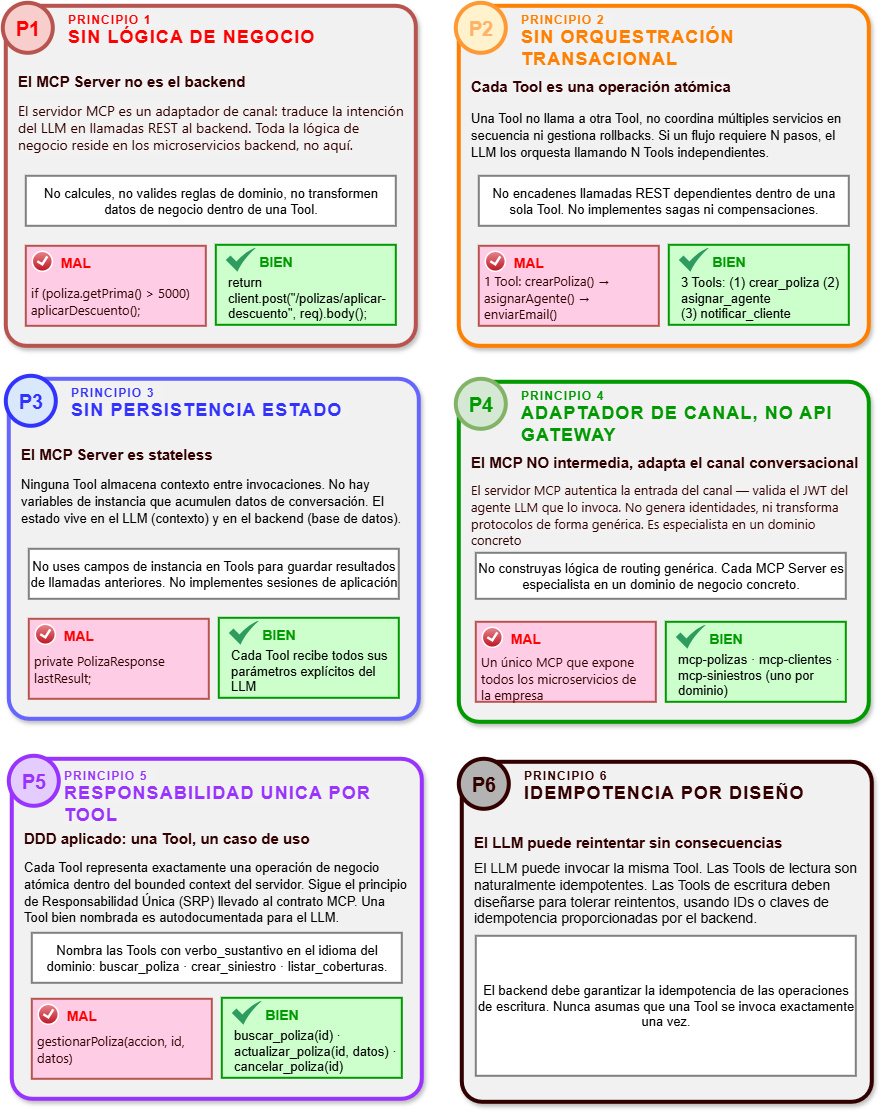
Six fundamental principles have been defined that must be considered during the analysis, design and implementation phases of any Keel-based MCP Server.
These principles should be understood as architectural guidelines, not merely as development recommendations. Following them keeps the MCP Server within its scope of responsibility, avoiding the inclusion of capabilities that belong to other layers of the architecture, such as business services, orchestrators or the API Gateway.
Together, these principles clearly delimit the scope and responsibilities of an MCP Server, establishing where its responsibility ends and where the responsibility of the rest of the platform begins.
Architectural principles
The following six principles are the reference guide for the design and development of any MCP Server within the Keel/MCP architecture.