01
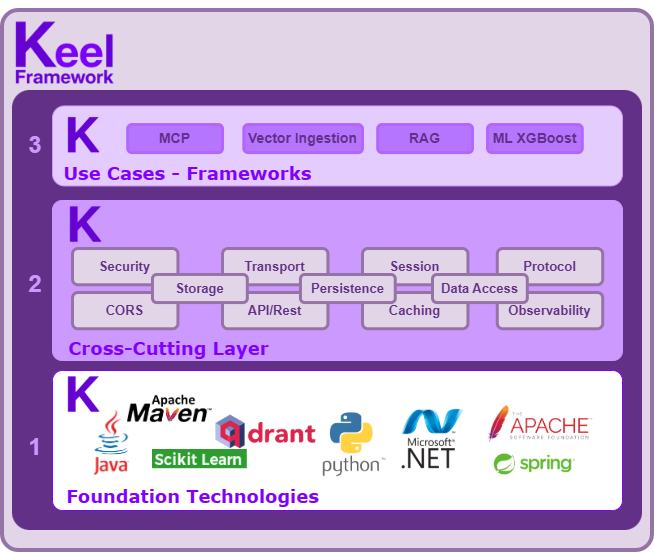
Foundation technologies
Keel does not try to replace the technologies it is built on.
It starts from mature ecosystems widely used in production, such as Spring, Apache or Python, and uses their capabilities instead of reinventing them.
The base technology provides the infrastructure.
Keel establishes how to use it consistently.
02
The Keel layer
On that foundation, Keel defines a reference architecture and encapsulates in independent modules the capabilities that are common to many projects.
Security, observability, transport, configuration, integration and other cross-cutting capabilities stop being decisions each team has to solve from scratch.
Keel also establishes development conventions, modular composition and centralized version management through BOMs, providing a common technical base for projects.
03
Frameworks by use case
From that architecture, specialized frameworks are built for concrete needs.
Each framework combines the technology foundation with the Keel capabilities and also provides the scaffolding needed to generate a project ready to develop the business logic and deploy it.
Today, that application is Keel MCP, aimed at building Model Context Protocol servers. Tomorrow, the same architecture can extend to new use cases and technologies.
The use case changes.
The architectural philosophy remains.